


Fox fur is fuller, more visible, and more dramatic. Mink fur is denser, smoother, and usually more polished. The better choice depends on the surface you want to wear.
The difference you see first
Fox fur coats and mink fur coats can both feel luxurious, but they do not speak the same visual language. Fox usually has longer hair, more volume, and a stronger outline. Mink usually has a shorter, denser, smoother surface that reads more compact and formal.
This article is a fur-type comparison, not the full Fur Coat Guide or the full fur coat buying guide.
If you are still deciding whether real fur is right at all, start with real fur vs faux fur. If you are building a complete purchase framework, use how to choose a fur coat.
Texture and volume
Fox fur is usually chosen when the coat is supposed to be noticed. The longer hair creates volume around the body, collar, sleeves, and hem. This can look rich and expressive, but it also makes the coat harder to treat as a quiet background layer.
 Fox volumeFox usually reads fuller, softer, and more visually dramatic.
 Mink polishMink usually reads smoother, quieter, and more compact.
Mink fur is usually chosen for density and polish. The surface tends to look smoother and more controlled. It can work better for formal outfits, cleaner silhouettes, and warmth without as much visual bulk.
Warmth, weight, and comfort
Both fox and mink can be warm when the coat is well made. Fox can feel plush because of its volume; mink can feel warm because of its dense compact surface. The final warmth depends on construction, lining, closure, and length as much as fur type. If warmth is the deciding factor, compare is real fur warmer than faux fur before choosing only by fur name.
Comfort is more about how the coat sits on the body. Fox volume can feel expressive but physically larger. Mink can feel more compact and easier to layer into polished outfits. Try to judge the coat in motion, not only on a hanger.
Price and value
Mink is often associated with a more classic luxury position, while fox can vary widely by color, origin, fullness, and garment construction. Price should not be judged by fur name alone. A stronger fox piece can be a better buy than a weak mink coat, and a well-cut mink coat can justify a higher price through longevity and wearability.
| Buyer priority | Fox fur may fit better | Mink fur may fit better |
|---|---|---|
| Visible texture | Strong choice | More restrained |
| Formal polish | Can work, but fuller | Usually stronger |
| Statement collar or trim | Excellent | Cleaner but less dramatic |
| Compact long-term wardrobe | Can feel too bold | Often easier |
| Photo impact | Very strong | Quieter and refined |
Which one fits your wardrobe?
Choose fox if your wardrobe can support volume: slim trousers, simple knits, winter boots, evening looks, or outfits where the coat is meant to lead. Choose mink if you want a smoother surface that pairs with tailored pieces, dresses, and cleaner winter dressing.

Color matters too. A bold fox coat can be beautiful but less repeatable. A neutral mink coat may be quieter but easier to wear for years. This is why the right choice is not only about status; it is about repeat use.
The buying check
- Look at the side profile, not only the front photo.
- Check whether the fur volume flatters your frame or overwhelms it.
- Compare surface density and consistency across sleeves, sides, and back.
- Try the coat with the shoes and trousers you actually wear.
- Use price only after material, construction, and repeat-use potential are clear.
If you need a general inspection sequence before comparing these fur types, use what to look for when buying a fur coat.
Color and silhouette change the comparison
Fox fur in a pale or high-contrast color can look very bold because the longer hair catches light and expands the outline. Mink in a dark neutral can read far quieter because the surface is compact and smoother. The same wardrobe may support fox in a short jacket but work better with mink in a longer coat.
 Color changes surface readThe same material family can feel different when color, length, and outfit context change.
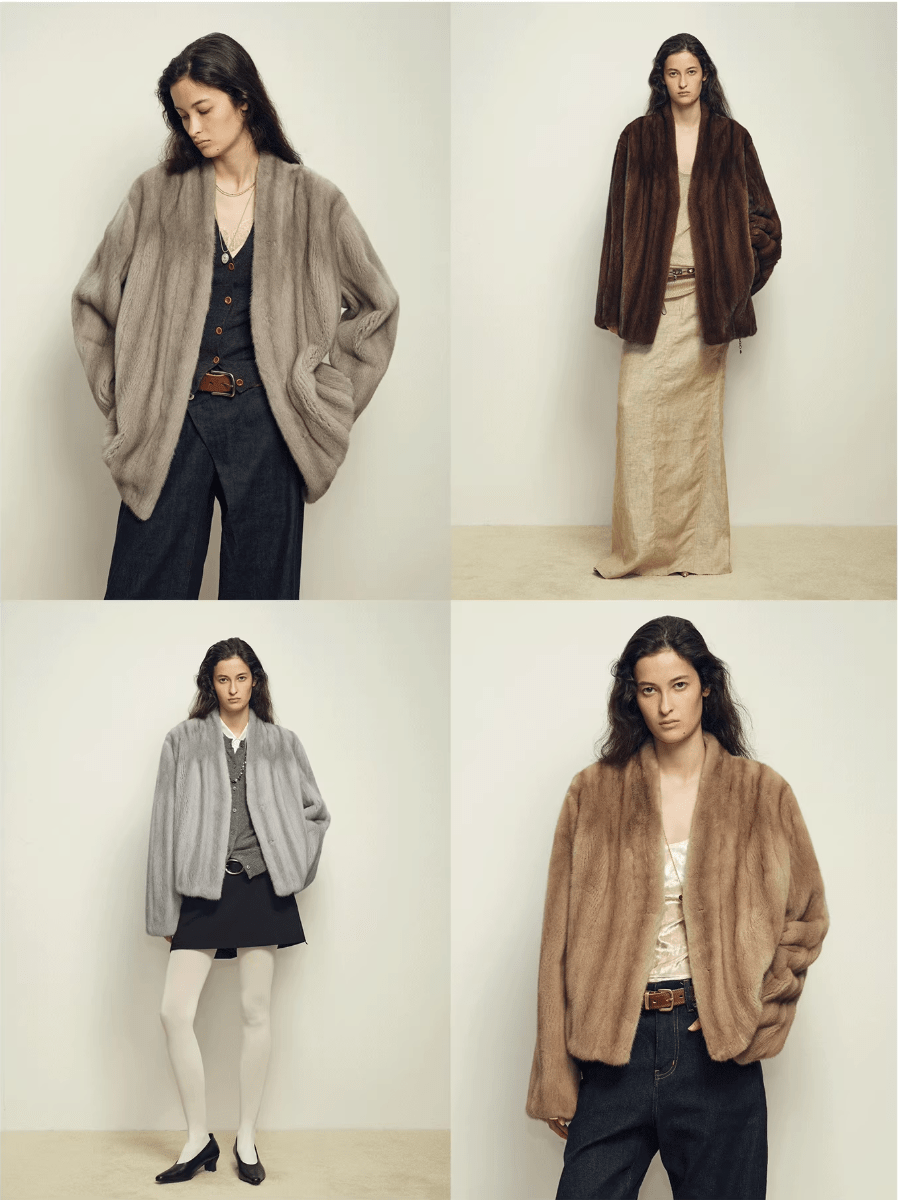 Multiple views matterUse more than one product angle before judging whether a surface feels too full or too quiet.
This is why fox versus mink should not be treated as a status ranking. It is a surface and silhouette decision. Fox gives more visual volume; mink gives more compact polish. The better material is the one whose surface still looks right with the rest of the outfit.
When each one can look wrong
- Fox can look too bulky if the rest of the outfit already has volume.
- Fox can overpower a petite frame when length, sleeve shape, and color are all dramatic.
- Mink can look too quiet if the goal is visible texture and a statement coat.
- Mink can feel overly formal if the wardrobe is mostly casual.
- Either fur can look weak if panel consistency, lining, or fit is poor.
Prestige is a weak filter here. Sometimes the better coat is not the fur type with the stronger luxury reputation; it is the surface that looks believable with the clothes, shoes, and occasions already in rotation.
How to inspect fox and mink differently
Do not inspect fox and mink with exactly the same eye. Fox should be checked for even fullness, attractive guard-hair direction, balanced volume, and whether the length of the hair overwhelms the silhouette. Mink should be checked for density, smoothness, panel consistency, and whether the surface looks rich without needing dramatic volume.

Also check how each fur behaves near the face. Fox around the collar can look glamorous but may feel visually large. Mink around the collar usually reads cleaner and more restrained. On a short jacket, fox can feel lively; on a long coat, the same volume may become too much for some wardrobes.
Price should come after this inspection. If the surface and silhouette do not match the wardrobe, a higher-status fur type will not fix the purchase.
A quick decision sequence
- Choose the surface mood first: visible drama for fox, compact polish for mink.
- Choose the silhouette second: short jacket, mid-length coat, long coat, or trim detail.
- Check whether the fur volume works with your frame and usual trousers, dresses, or boots.
- Inspect surface consistency and construction before giving price too much authority.
- Use collection browsing only after the material role is clear.
This sequence keeps fox and mink from becoming abstract luxury labels. The right choice is a wearable surface, not a vocabulary preference.
How this comparison supports the broader buying guide
Fox versus mink should support the larger buying journey by clarifying surface, not by pretending fur type alone decides quality. First set the budget, then choose material, then inspect fit and construction. This page helps with the material stage: what kind of surface, volume, and wardrobe signal should the coat carry?
After that, use the checklist. A beautiful fox coat can still be poorly constructed. A sleek mink coat can still fit badly. The fur type narrows the search; it does not replace inspection.
How FireladyFur compares fur types
FireladyFur compares fur types by surface behavior first. Fox is judged by volume, guard-hair length, color impact, and silhouette; mink is judged by density, smoothness, polish, and whether the surface stays controlled in motion.
That keeps the comparison practical: fox and mink are not status labels but different textures, weights, volumes, and styling signals.
Choose the surface you want to live with
Fox gives more volume and drama. Mink gives a denser, smoother, more polished finish. Compare the surface against your real outfits before choosing.
FAQ
Is fox fur warmer than mink fur?
Both can be warm when well made. Fox often feels plush because of volume, while mink can feel warm through dense compact fur and good construction.
Is mink more formal than fox fur?
Usually yes. Mink tends to read smoother and more polished, while fox is fuller and more expressive.
Which is better for a statement coat?
Fox is usually stronger for a statement coat because of its volume and visible texture.
Which is easier to wear long term?
Mink is often easier for a quieter long-term wardrobe, especially in neutral colors and cleaner silhouettes.


